Electrochlorination – Chemical Prevention of Marine Fouling
Continuous protection for seawater lines through controlled hypochlorite generation
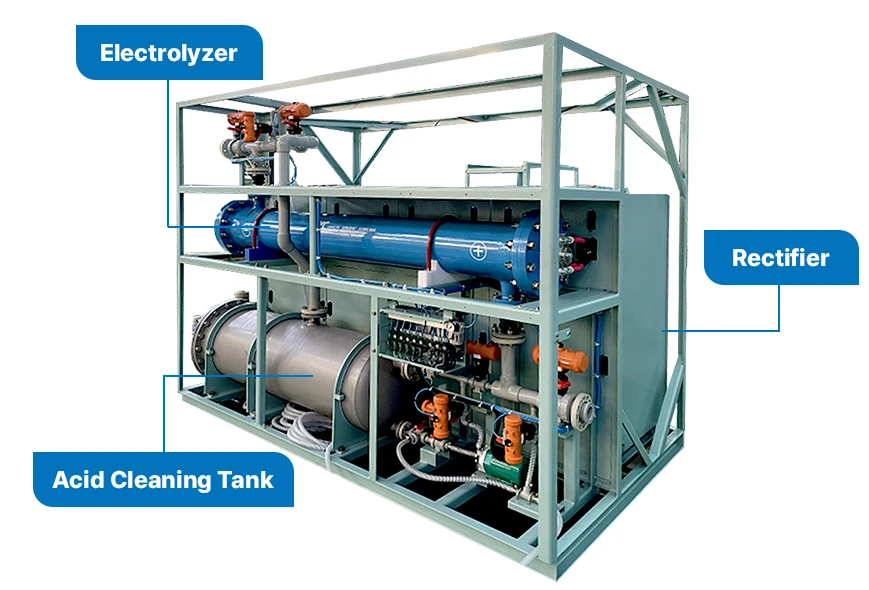
The electrochlorination system is a highly effective solution for preventing marine fouling in seawater intakes, piping, and heat exchangers aboard vessels and offshore units. Based on a process that involves the electrolysis of seawater, the system generates active chlorine compounds that inhibit the growth of biological organisms along internal saltwater lines.
How the process works
Seawater is drawn directly from the discharge of a standard pump or a pump dedicated to the MGPS system and fed into a generator chamber (electrolyzer). In this chamber, using specially designed titanium electrodes, the saltwater undergoes electrolysis, resulting in the formation of active chlorine (primarily sodium hypochlorite).
This agent is then injected at strategic points in the system, such as seawater intakes and filters, where it mixes with the incoming water and protects internal surfaces against the growth of marine organisms such as barnacles, mussels, and algae.
Major chemical reactions
Formation of Chlorine (at the anode): 2Cl⁻ → Cl₂ + 2e⁻
Sodium hypochlorite (NaOCl) solution acts as a powerful oxidizing agent, preventing the attachment of fouling organisms and eliminating microorganisms present in the water.
Proven effectiveness
Continuous concentrations of just 0.2 to 0.5 ppm of active chlorine are sufficient to prevent scaling over time.
Maintaining this concentration ensures the elimination of living organisms, even in environments with a high biological load.
Adult organisms, such as mussels, tend to avoid settling in treated areas because they are unable to feed in the constant presence of active chlorine.
Operational Considerations
Concentrations above 0.5 ppm can cause corrosion in metal pipes, requiring proper sizing and monitoring.
The system is ideal for use in continuous operations, where constant chlorination provides the best balance between efficiency, microbiological safety, and environmental control.
Typical Applications
Sea chests
Intake filters and saltwater distribution networks
Heat Exchangers and Cooling Systems
Industrial seawater circulation systems
Advantages of the MCP Marine Electrochlorination System
Continuous and fully automated system
On-site hypochlorite generation— no need to store chemicals
High anti-fouling and bactericidal efficacy
Ideal for medium- and large-sized vessels
Cost savings on chemical cleaning and mechanical maintenance